Storing and caring for historical leather goods
 Download PDF
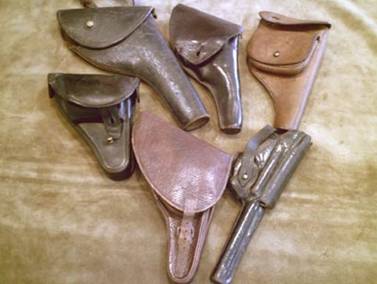
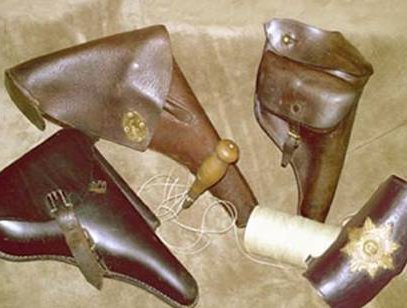
Pistol cases, cartridge pouches, sabre scabbards, belt equipment, etc. Historical leather equipment is often very old and sensitive. This article shows how to care for and store it properly so that it is preserved for a long time.
What is historical leather equipment?
Historical leather equipment refers to leather gear associated with historical weapons and military equipment, mainly from the 18th and 19th centuries. Typical items include:
- Pistol cases and holsters → containers for handguns, often made of multi-layered, stitched cowhide
- Cartridge pouches → containers for ammunition, often with brass fittings and rivets
- Sabre scabbards → leather-covered scabbards with metal or leather binding
- Bayonet scabbards → scabbards for edged weapons, often more simply made
- Belt equipment → belts, straps, cords and connecting parts of the carrying system
- Canteen covers, knapsacks, cartridge boxes
- Other equipment items made of leather
These objects are generally made of vegetable-tanned cowhide, an old, robust tanning method that is nevertheless very sensitive to certain substances if cared for incorrectly. The leather is often 100 to 200 years old, dried out, brittle and altered in colour.
What damages old leather?
Dryness
Dryness causes old leather to lose the water bound in its fibres; it becomes brittle, cracked and shrinks. This damage can no longer be remedied, or only partially with considerable effort.
→ Never store leather below 35% humidity.
Mould
Excessive humidity above 70% leads to mould growth. Mould destroys leather fibres because it feeds on proteins and fatty acids. Vegetable and animal fats contained in most commercially available care products become breeding grounds. In addition, so-called hydrolysis (the destruction of fibre molecules by reaction with water) damages the leather structure in the long term.
→ Humidity of 45–65% is ideal. Store in a well-ventilated place, never in bags or closed containers.
Light and heat
Extreme exposure to light and temperature noticeably accelerates the degradation process.
→ Store at room temperatures of 18–20°C and protect from direct sunlight.
Mechanical stress
What harms old people also harms old leather. Do not bend it too much or overuse it. Do not fold or crease it.
Dirt and lack of care
Contamination is a source of oxidation and damages the leather. Lack of care accelerates the degradation process.
→ Clean only when there is actual soiling. Regular but sparing care extends its lifespan.
How to treat it?
NOTE:
Always test all applications and products first on a small area. Very old leather has sometimes not been properly tanned. Undesired changes cannot always be ruled out.
Cleaning
Wipe away old grease and greasy dirt lightly several times with Leather Cleaning Spirit. Do not use water-based cleaners; water can irreversibly damage old leather.
Neutralising and stabilising
Where hand sweat or incorrect care products (for example saddle soap) have discoloured or dried out the leather:
Carefully neutralise with a solution of 2 parts water and 1 part vinegar essence (25% solution, available from chemists). Do not soak it; only wipe it with a lightly moistened cloth and repeat. In the case of severe mould infestation, a 1:1 ratio (water to vinegar essence) can also be used.
CAUTION: Red rot:
If the leather has become powdery, spongy or reddish, there is a high probability of irreparable damage: so-called «red rot». This was caused by the use of sulphuric acid and unstable tanning agents in leather production until the middle of the 19th century. In addition to local tanning agents from oak, birch or chestnut, cheaper wood tanning agents from the colonies (mimosa, quebracho) were used at that time. New synthetic dyes required acids for fixing, and these have had a negative long-term effect on the stability of tanning agents. Red rot cannot be remedied.
Preserving the grain side (outer side)
Treat the leather on the grain side (outer side) with Colourlock Elephant Leather Preserver; it is acid-free and synthetic, ideal for old leather. Apply only thinly, allow it to absorb and polish with a woollen cloth.
→ Never seal the reverse side with pure grease; this has no deep effect. In very inaccessible places, especially around seams, Colourlock Old Leather Softener can additionally be applied with a fine brush; the linen threads used in the past have also dried out and become brittle.
→ Vegetable and animal greases from equestrian-care products, saddle soap and ordinary creams damage old leather, even if they are suitable for new leather of the same type.
Improving the appearance of the surface
Small tears and abrasions can be closed with Colourlock Leather Glue (link to the product) after degreasing.
→ Do not use superglue or quick-setting adhesives, as they destroy the leather. Colour matching, filling work and wax finishing require specialist knowledge and experience. Please contact us if you are unsure.
Storage
Store the leather equipment in well-tempered rooms (18–20°C) with little sunlight and humidity between 45% and 65%. Very dry leather can tolerate humidity of up to 70% for a short time (4–5 weeks).
Inspection and maintenance
If the leather equipment is in good condition, an annual inspection is sufficient. It benefits the leather to wipe it lightly with the water-vinegar solution and apply a very thin layer of grease. In the event of mould infestation, repeat the procedure described above intensively.
Product recommendations
Note:
(Clicking on products adds them to the shopping basket, where they can then be ordered)
- Leather Cleaning Spirit
- Elephant Leather Preserver
- Old Leather Softener
- Leather Glue
Choose colours
Please configure every selected colour product before adding the selection to the cart.